

Building JP Patterns: A Brand Case Study
Built with AI. Directed by design.
I built JP Patterns from the ground up, combining AI-generated artwork with hands-on Illustrator refinement and 3D design.
From individual motifs to fabric, lighting, and camera composition, each stage became more deliberate as my process evolved.

More control. Better process.
01 / Generate, trace, refine
AI was part of JP Patterns from the beginning. I generated artwork, traced it in Illustrator, and refined each design by hand. Early results offered limited control over color, placement, and motifs.
02 / Build a more deliberate process
I developed guidelines for flatter artwork and smaller color palettes to simplify tracing. For complex patterns, I generated individual motifs, then edited and assembled them myself. Better direction gave me more control and a more efficient workflow.
03 / Shape the scene
I first used my 3D skills to advertise fabric without ordering printed samples. As AI helped build richer starting scenes, I refined the details myself: adding curtain loops, moving objects, and adjusting the setup. My design and 3D knowledge guided those decisions.
04 / Direct the camera. Preserve the pattern.
I often changed camera angles and framing, drawing on my experience behind a camera to strengthen the composition. Applying the actual pattern through UV mapping let me control its scale and placement. The finished advertising brought together AI assistance, hands-on 3D work, and my eye as a designer.

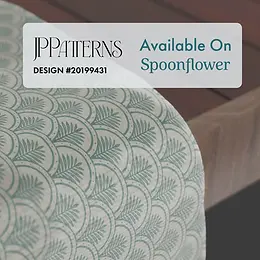
01 / EARLY ADVERTISING
I used simple fabric setups, folds, and lighting to show my patterns without ordering printed samples.

02 / CRAFTED IN BLENDER
I built and refined fabric presentations in Blender, controlling folds, materials, lighting, and camera composition.

03 / AI AGENT ASSISTED SCENES
AI helped build richer starting scenes. I refined the details, directed the camera, and applied my actual patterns through UV mapping.

The modeled couch, curtain, and cushion beside the finished pattern presentation.

The modeled bedding scene and its finished pattern presentation.

An earlier promotional layout pairing fabric rolls with campaign typography.
The modeled couch, curtain, and cushion beside the finished pattern presentation.
From scene to campaign
Using voice dictation, I direct an AI agent connected to Blender through MCP. I describe the scene, how it should look, and where my fabric patterns should appear. The agent helps build that starting point, while I refine the details, adjust the camera, and control how the patterns are applied.
My role has shifted toward creative direction. Spending less time constructing couches, curtains, and complex scenes gives me more time to develop patterns, shape compositions, and create finished advertising.